A life offered freely and because of love
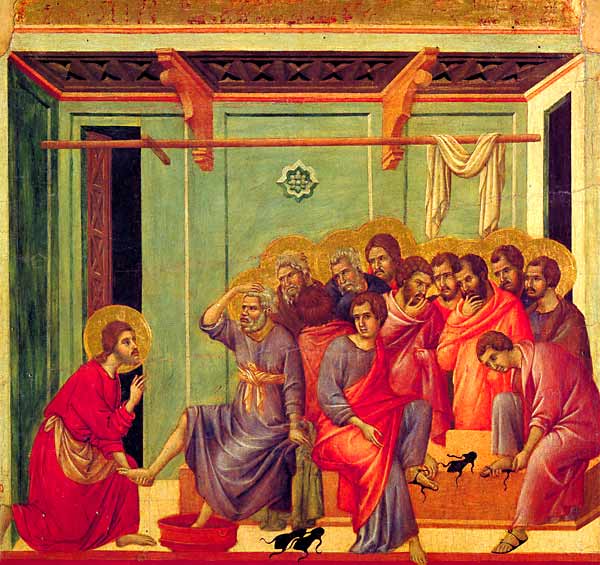
Jesus, the Kyrios, the Lord, washes his disciples’ feet. That’s an anomalous, paradoxical, roles inverter and scandalous gesture
On Holy Thursday, at sunset, the Easter Triduum begins. In these “holy days” separated from the other ones we, the Christian people, meditate, celebrate and live again the central mystery of our faith: Jesus goes into his Passion, knows his death and burial and the third day he is resurrected by the Father in that strength of life that is the Holy Spirit. But was this event of Jesus’ Passion due to chance or to a fate that impended over Him? Why did Jesus know a sentence, the torture and the violent death? These are questions to be answered if we want to catch and deeply understand the meaning of the Passion. And it is exactly the Gospels that want to give us this answer witnessing the events of those Easter days in the thirtieth year of our era. As a matter of fact in order to show to his disciples that he was going into his Passion assuming it as an act, not obliged by fate nor as a consequence of a series of fortuitous and unfavourable circumstances, Jesus anticipates with a mime, a symbolic gesture, what is about to happen to him, thus revealing the meaning of it. Therefore, Jesus accepts freely the end looming before him. He could have fled away or avoided to face that trial and, yes, he asked the Father if this was possible. But if Jesus wanted to dwell in justice, if he wanted to stay on the side of the just (always opposed and persecuted in an unjust world), if he wanted to stay in solidarity with the victims, the lambs of history, he had to accept that sentence and that death. He did accept it freely so that the Father’s will was done. Obviously the Father did not want the death of His son, but the Father’s will required that Jesus remained in the reign of justice, love, solidarity with the victims.
But Jesus’ freedom was fed and accompanied also by love: love for the Father, surely, but also for truth and justice, love for us, for the man. Yes, exactly in order to show that he was renouncing his life freely and because of love — not obliged by fate or fortuitous circumstances — Jesus anticipates through some signs what is about to happen to him. At table with his disciples, Jesus makes some acts on bread and wine accompanied by his words: his body is broken and given for the man, his blood is poured and given for everybody. And the sign of his imminent death, the sacrament of giving thanks, is the Eucharist that the Christian will have to celebrate in memory of Jesus in order to be involved in the deed of giving life for the brothers, for the others. At the end of that act, Jesus exclaimed: “Do this in memory of me”. In the celebration of that gesture made by their Master and Lord, the Christians who live in the world in all the times from Jesus’ death- resurrection till his return, his coming back in glory, will be moulded as his disciples, they will be part of Christ’s life, they will know that he, the Lord, will be with them till the end of history.
Therefore the Holy Thursday has to celebrate this event which anticipates Jesus’ Passion, the narration of his exodus from this world to the Father. But in the evening liturgy of the Holy Thursday, besides remembering and living as in every Eucharist this gesture of its Lord, the Church significantly lives and repeats another gesture made by Him, i.e. the Maundy. As a matter of fact, also the fourth Gospel narrates “Jesus’ last supper with his disciples”, the supper during which the traitor’s identity was revealed, Peter’s denial and all the other disciples’ flight were announced; the supper made on the occasion of Jesus’ last Passover in Jerusalem before his death. But instead of narrating the sign of the bread and the wine, John tells the sign of the Maundy! Why a “different” gesture, a “different” sign? And yet the fourth evangelist knows the story of the Eucharist, because the Church had been celebrating this sacrament for decades by then. Why then the remembrance of this different sign? We can deem quite probable that this choice in the fourth Gospel is motivated by an urgency felt in the Church at the end of the first century: the Eucharistic celebration can’t be a rite disjoined from a consistent praxis of agape, of love, of service towards the brothers, as this is exactly its meaning: to give one’s life for the brothers!
Thus, the evangelist wants to bring up-to-date the Eucharistic message remembering that if it is not a mutual service, the gift of one’s life for the brothers, an extreme love, it becomes just a rite belonging to “the scene” of this world. We could say that John’s purpose is to make the altar’s sacrament always read and lived as the brother’s sacrament. Eucharistic celebration with the broken bread and the offered wine and the concrete daily service to the brother attract each other mutually as two faces of the participation to Christ’s Easter mystery. Here is then Jesus’ gesture narrated slowly, almost in slow- motion, so that it may be well impressed in the mind of the disciple of every time: Jesus takes off his clothes, takes a towel, puts it round his hips, pours the water in the basin, washes the disciples’ feet, dries them, takes his clothes again… These are action verbs which plastically convey the event of the Maundy. It is a gesture made by Jesus in complete awareness: Jesus, the Kyrios, the Lord, washes his disciples’ feet. That’s an anomalous, paradoxical, roles inverter gesture; a scandalous gesture, as Peter’s reaction shows! And yet, it’s exactly in this way that Jesus tells, “evangelize” God, in the sense of making Him “Gospel” for us.
Two different actions, two sacramental mimes, two signs narrating the same reality: Jesus offers his life and, freely and because of love, goes towards his death turning himself into a slave. Because of this, the same command follows the Eucharistic gesture and the Maundy: “I washed your feet, do as I did”. And that’s what the Church has to do if it wants to be the Lord’s Church and wants to obey its mandate: it has to break the bread, offer the wine, wash the feet in the assembly of the believers and in the history of the man.
Translated from:
ENZO BIANCHI
{link_prodotto:id=320}. Le feste cristiane
Edizioni Qiqajon, 2003, pp. 73-76.