Good news for the sinners!
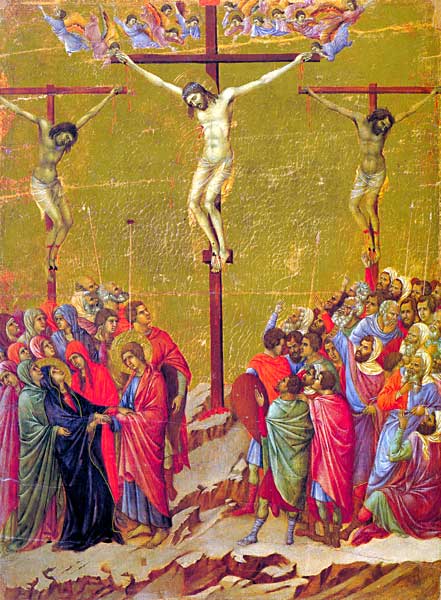
The cross doesn’t make great the one who is hung on it, but Jesus is he who redeems the cross and gives a meaning to it
Good Friday is a severe day for Christians, a day which is still felt as an “anti-festivity”, which is still able to isolate tragically Jesus’ passion and death from his resurrection. When Christians go to their Lord, they are always brought back to the one event of the passion-death-resurrection. But today what is meditated, thought of, and celebrated, is the passion, culminated in the death. It is the cross which dominates the liturgy with its shadow and which, by imposing itself, makes us think of the resurrection just as hope, just as a wait. Peculiarity of the Christian faith is to have the crucified Jesus as its core message and to feel Jesus’ crucifixion as God’s most revealing tale. What do Christians commemorate every year on Good Friday?
They commemorate what happened in Jerusalem, the holy city and the heart of the Jewish faith, in the 30th year of our era on Friday, April 7th. Jesus from Nazareth — a rabbi and a prophet who had aroused a movement around him and who used to be followed by a little itinerant community composed of a dozen men and some women — was arrested, sentenced and put to death through the torment of the crucifixion. From a historical point of view we can say that Jesus was arrested on the initiative of some high priests, the hierocracy of Jerusalem, because of some of his deeds and some of his words, such as some messianic traits in his deeds, the passionate expulsion of the sellers from the Temple, the prophetical polemic against the religious men, especially the Sadducees.
Caught by night in the Cedron Valley by a handful of guards of the Temple, he was dragged to the High Priest, in the presence of whom there was a confrontation which permitted to set forth precise indictments which could be presented to the Roman Governor, the only one who had the power to pass death sentence and to order to execute it. We must say clearly that there was not a due process of law and that the members of the Sanhedrin which met at night were almost certainly not able to deliberate in a legal situation. Jesus was all the same given in charge of Pilate who, after some sessions and procedures which seemed to be a real trial, decided to condemn him with two other criminals after making him flagellated. Was this a precautionary measure, an attempt to please the priests who had given Jesus in charge of him, or was it hate towards anyone among the Judeans who seemed to transmit a message not in line with the imperial ideology? It’s likely that all these reasons together led Pilate to the decision of condemning that Galilean. What is certain is that Jesus dies on the cross, going through what according to the Romans was “an extremely cruel and horrible torture” (Cicero) and according to the Jews was, like the hanging, an excommunication sign for the sinner, a God’s curse for the blasphemer, as the Torah says: “Damned is anyone who is hung on the wood” (Deuteronomy 21:23; see the Epistle to the Galatians 3:13). Jesus dies in the infamy of his nakedness, hung half-way up, because neither the earth nor the sky want him. He dies in the shame of those who are condemned by the official law of their own religion, or by the civil authority because of their being harmful to the common good of the polis! Unlike John the Baptist, Jesus doesn’t die as a martyr, but as an excommunicated and cursed man, using an expression loved by Paul, who is proud of preaching the crucified Jesus, a scandal for the religious men and a folly for the wise men of the Greek world.
The cross, yes, the cross is the sign of Jesus’ infamous death — “Jesus who is counted among the criminals”, as the evangelists like noticing —, it is the tale of his sympathy with the victims, of his stooping to the condition of a humiliated slave, “to the death and the death on the cross”, as Paul witnesses. Nevertheless, the cross must not prevail over the Crucified! As a matter of fact, the cross doesn’t make great the one who is hung on it, but Jesus is he who redeems the cross and gives a meaning to it, so that everyone who knows this situation of suffering and shame, of curse and annihilation, could find Jesus next to him. Each cross is an enigma turned into a mystery by Jesus: in an unjust world, the just can only be refused, opposed, condemned. This is a necessitas humana (human need) and Jesus — exactly because he wanted to “remain just”, in solidarity with the victims, the lambs — had to know the clash between him and the injustice of this world. But those who are able to read Jesus’ passion and death in this way have to understand it as a glorious event for Him: the glory of he who has spent his life for the mankind, the glory of he who has loved to the end, the glory of he who dies condemned for having tried to tell that God is mercy, is love. If there is a place where Jesus turned God into “Gospel”, where he “evangelized” Him, that place is exactly the cross, good news for all the sinners!
Today, Good Friday, Christians gather all the victims of history, all the lambs killed by the wolves, in the image of the Crucified, the innocent lamb. During this day Christians are asked to learn to sustain the scandal of the cross without blaming the other, in the certainty that behind the cross of each just man it is possible to see a reason for giving one’s life for the other. Only he who has a reason for which giving his own life is worthwhile, has also a reason for which living is worthwhile.
Translated from:
ENZO BIANCHI
{link_prodotto:id=320}. Le feste cristiane
Edizioni Qiqajon, 2003, pp. 79-82.