God's silence, man's silence
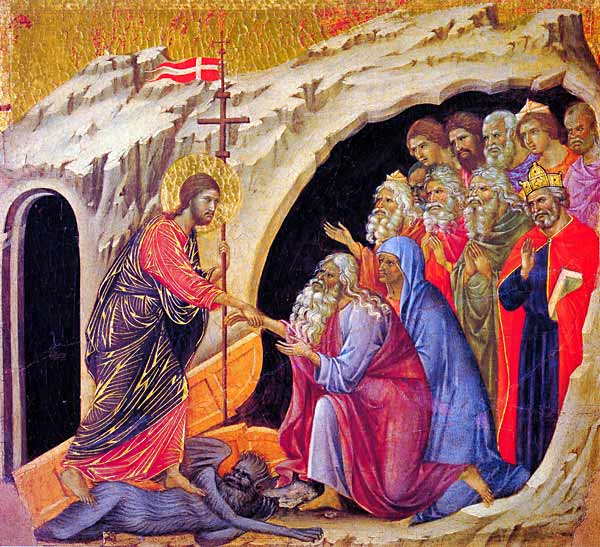
Today Christians should not forget the mystery of the Great and Holy Saturday, a real prelude to Easter. There is no Easter dawn without a Holy Saturday
Speaking of the Holy Saturday may seem paradoxical because for Christians this is a day characterized by silence, a day which may seem a “dead time,” emptied of all meaning. Also the Gospels are silent on this “Great Saturday.” The narration of the Passion ends with the night of Friday, when Saturday dawn is breaking, and it restarts at dawn of the first day of the week, i.e. the third day. Is this then an empty day? In the Western Christian tradition, the Holy Saturday is the only day without a Eucharistic celebration, the only day which has remained without a liturgy, without a particular celebration: the bells are silent, there are no little flames in the bare churches, no chants. Christians’ prayer gets silent as well and it is chiefly a prayer of wait, a wait for what will deeply change each thing, each life story. We certainly know well that Easter is an event which happened eph’hapax, once and forever, in the 30th year of our era, on April, the 9th; we know that Christ, who is resurrected by now, will not die again, we are aware of our not being celebrating a cyclic mystery as the heathens did. Nevertheless we are asked to live this day catching its very meaning. We live it in the faith that the crucified Lord is living among us. But, by choosing the second day of the Easter Triduum as the day of silence, of the wait, of the “not said,” we assume a dimension which always dwells inside us and which is sometimes — in our life, in other men’s life, or in an entire people’s life — the lasting, not momentary, not transitory dimension.
On Holy Saturday, the day after death, when there was the end of hope before the disciples, an aporia, an emptiness over which the absence of meaning, the unbearable suffering, the laceration of a final separation, of a mortal wound impended: where is God? This is the mute question on Holy Saturday. Where is that God who had intervened at the moment of Jesus’ baptism, opening the skies to tell him: “You are my son, in You I am well pleased” (Mark 1:11)? Where is that God who had intervened on the high mountain at the moment of the transfiguration with Moses and Elijah, who had said: “This is my son, the Beloved!” (Mark 9:7)? At the moment of the cross God did not intervene, to such a point that Jesus felt himself abandoned by God and cried to Him: “My God, my God, why have you forsaken me?” (Mark 15:34). A whole day passes by and there is no God’s intervention… And yet God has not forsaken Jesus. The abandonment seems to be the bitter truth before the disciples’ eyes, but actually God has already called Jesus to Him, indeed, he has already resurrected him in his Holy Spirit and Jesus is alive in the nether world announcing salvation there as well. “He descended to the nether world,” we profess in the Credo. This is what happens in the hiding on the Holy Saturday: an empty, silent day for the disciples and for the men, but a day during which the Father — who “is always working” (see John 5:17), as Jesus said — brings salvation to the nether world by means of Jesus. Just as Jonah was in the belly of a fish for three days and three nights (see Matthew 12:40), Jesus was taken down from the cross and laid in the grave, and from there he descended again to the nether world, to the Sheol where the dead dwell.
This a great mystery, on which today the Church seems to prefer to remain silent, almost as if it were aphonic. And yet the Fathers of the Church, mainly in the ancient liturgy, wanted to sing this action done after his death. In a homily attributed to Epiphanes we read: “Today there is a great silence on earth. The Lord died in the flesh and has descended to the nether world to shake it. He goes to look for Adam, the first father, as if he were looking for the lost sheep. The Lord descends to see those who lay in the darkness and in the shadow of death.” And this is what we read in a hymn by Ephrem the Syrian: “He who had said to Adam ‘Where are you?’ descended to the nether world after him, he found him, he called him and said to him ‘You, created in my image and likeness, come! I descended to the place where you are, to bring you back to your promised land!’.” Jesus who, by means of his death, descended to the nether world — a death which became an “act,” a death which was assumed and completely felt — destroyed the very death in an admirable fight, as the Syriac liturgy recalls: “You, Lord, you had been fighting against the death for the three days of your dwelling in the grave, you sowed joy and hope among those who dwelt in the nether world.”
Therefore, the descent to the nether world becomes the extension of the salvation of all the universe, of the human being in his wholeness: Christ descends to the heart of the earth, to the heart of creation, to the nether regions dwelling inside each man. What will become then of the nether world, after “its being visited” by the glorious Christ? Cyril of Alexandria states that Christ’s preaching in the nether world — about which Peter the Apostle says: “put to death in his flesh, but made alive in his Spirit, he went to announce salvation to the spirits who were waiting in prison” (1 Peter 3:18-19) — meant that Jesus emptied it: “Immediately Christ, emptying the whole hell and opening its impenetrable doors wide for the spirits of the dead, left the devil alone there.” Hell, where is your victory?
Today Christians should not forget the mystery of the Great and Holy Saturday, a real prelude to Easter and to the reading of Christ’s descent to the nether regions which dwell inside each Christian as well, in spite of his wish to follow Jesus. Who doesn’t recognize inside himself the presence of these nether regions? Regions which are not evangelized, zones of incredulity, places where God is absent, and where we can do nothing but invoke Christ’s descent so that he may evangelize them, enlighten them, change them from regions of death under the rule of the devil into fertile ground able to germinate life, thanks to God’s grace. Thus, the Holy Saturday is like the time of pregnancy, it is a time growth towards the childbirth, towards the triumph of a new life: its silence is not muteness, but it is a time full of energy and life.
What then could hold us back from thinking of the last century as the century during which the Holy Saturday was the experience of many people who believed in Jesus and of many other men whose faith is known and led only by God? In the concentration camps under the Nazi rule, in the gulag and in the Soviet prisons, in many countries where the atheistic communist ideology gave new martyrs to the Church, as on a deep Holy Saturday… A few years ago, I met a bishop in China who belonged to that Church which, officially, is not in communion with Rome and he said to me in Latin: “We live the Holy Saturday, but we are waiting for Easter: it will come! Tell the Holy Father that we love him.” On Holy Saturday God seems to be absent, evil seems to prevail, suffering seems to have no meaning, and where is God? Sometimes it’s Holy Saturday also for those who meet the darkness along the path of their faith, those who see it wavering, those who can feel no more hope. A day of callousness, during which each confidence seems to be inaccessible and too great to be conceived. Then there is the Holy Saturday of many sick people, above all the ones who suffer from Aids, who are bound to Jesus in his shame… But Holy Saturday can also be seen as the time when the blood of the martyrs and of the victims falls as a seed on the earth in order to fecundate it in view of a plentiful fruit, a time during which the decay of our outward being leaves room for the growth of our inner man… Everyone who will speak of his Holy Saturday will be able to say then: “Surely the Lord was in this place and I did not know it!” (Genesis 28:16). There is no Easter dawn without a Holy Saturday.
Translated from:
ENZO BIANCHI
{link_prodotto:id=320}, Le feste cristiane
Edizioni Qiqajon, 2003, pp. 85-89.