A plural unity
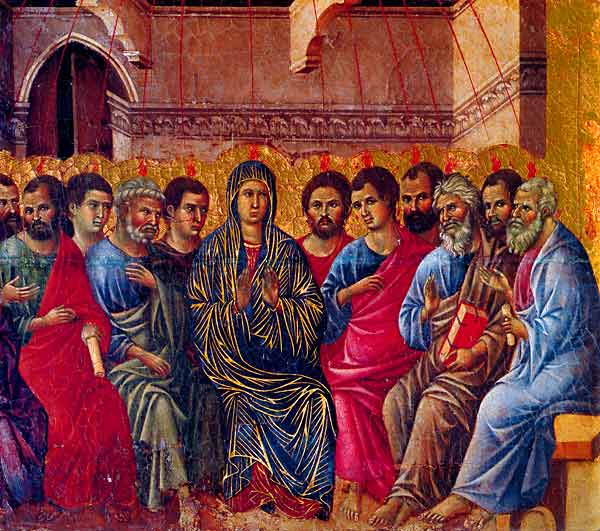
The Church must not impose its language, but it has to enter men’s languages in order to announce the wonders of God
According to the fourth Gospel, on the very day of his resurrection, Jesus came among his disciples, greeted them giving them his peace and making himself known through the signs of his passion and death, which were still visible in his hands and side, “breathed on them and said: Receive the Holy Spirit.” In the Acts of the Apostles, after Jesus has ascended to the Father, while the disciples are gathered together in the same place, the Holy Spirit descends, in the form of a sound and of a strong rushing wind, as a fire showing itself in flaming tongues.
John’s and Luke’s narrations want to tell us above all that the same Spirit which was sent by the Father and which resurrected Jesus from the dead giving him a new life, was given by Jesus to his disciples: thus, Jesus and his community live of the same spirit, the holy Spirit. Pentecost is then the fullness of the Easter revelation, because the energies of the resurrected Jesus flow into his community which, thanks to the Holy Spirit, reaches faith in Jesus Christ, the son of God, and the ability to witness him and to announce him in history and to all men.
For the people of Israel, Pentecost was a feast in memory of the gift of the Law on Mount Sinai, the feast of the alliance. Now, the gift of the Spirit makes Pentecost the celebration of the new, last and definitive alliance for the community of God. Jesus didn’t leave his Church alone nor, through his ascension into heaven, there was a great separation which put an end to his work in the world. As a matter of fact, the community of the believers shares the same life and Spirit with the Lord Jesus, and this makes them qualified to continue Jesus’ work: “To announce the good news, to do the good, to heal those who are under the power of Satan.” By means of the Pentecost, Jesus’ Church was consecrated in the Holy Spirit and thus qualified for the mission, in the same way as He had been (see Acts 10:38).
Exactly for this reason the fourth gospel lays emphasis on the fact that the holy Spirit is given so that the disciples announce the remission of sins and gather the scattered sons of God, whereas the Acts witness that the risen Lord’s announcement is made in different languages by the Church, in the ways the Spirit gave the apostles the ability to express themselves (see Acts 2:3-4). After the apostles received the holy Spirit through the miracle of the tongues of fire, the words announcing the Risen Lord, the good news, are understood by Parthians, Medes and Elamites and by the various inhabitants of the several countries of the Mediterranean area. Bernard of Clairvaux wrote: “The Spirit descended upon the disciples in tongues of fire so that they could say words of fire in the languages of all peoples and could announce a fiery law by means of tongues of fire.”
The feast of Pentecost is the gathering of the scattered sons of God, an anti-Babel, the beginning of the last times, the times of the Church. In Babel there had been the confusion of the languages and the attempt to link steadily heaven and earth by building a tower which went up to the sky, but on the day of Pentecost what happens is the miracle of the languages heard and understood by everybody, and it is the Spirit to descend and to put men in touch and communion with God. It is the miracle of an understanding recovered inside a word! Yes, the variety of men’s languages will continue to exist, and this plurality of languages, cultures, history is not cancelled: as a matter of fact, the Holy Spirit creates a variegated unity, a plural unity, exactly as many gifts and limbs form together the body of the Lord, i.e. the Church. Difference must exist without cancelling unity and unity must assert itself without repressing multiplicity.
The miracle of the languages aroused by the Holy Spirit indicates to the Church the task of reconciling the unity of God’s word with the plurality of the ways in which this word has to be lived and announced in the only community of the believers and among all peoples. It is in this way that the Church must not impose its language, but it has to enter men’s languages in order to announce the wonders of God according to their different forms and ways of understanding them.
Still today, the Spirit poured forth on Pentecost binds the Church to create paths and to invent ways to make the otherness a cause of communion, not of conflict or hostility. Thus the Church, i.e. every Christian community, will be able to be the sign of the universal kingdom which will come and to which the whole mankind is called through, not in spite of, the differences going through it. All this sharpens the sensitiveness and care that Christians should have for ecumenism and the dialogue with the other religions. The awareness of the Jewish roots of the Christian faith, of the never-ending Jesus’ Jewishness, of Israel as being the people of the never revoked alliance, and at the same time the awareness of the universal destination of the Christian salvation and of the multiplicity of the peoples and cultures in which the gospel is called to throw its seeds, should be part of every mature Christian’s equipment together with the awareness that ecumenism is a constitutive element of the faith of every baptized Christian, who is called, as a Jesus’ follower, to pray and work to remove the scandalous divisions among Christians.
Translated from:
ENZO BIANCHI
{link_prodotto:id=320}: Le feste cristiane,
Edizioni Qiqajon, 2003, pp. 103-105.