A promise for disfigured mankind
The Christian holidays
by ENZO BIANCHI
The Transfiguration is the sign worked by God to conform us to his Son, till he makes us like him; it is also the warrant that all our being will be transfigured
6 August, Transfiguration of the Lord
O Cristo parola di vita
BROTHERS AND SISTERS
OF BOSE
“I’ve seen a great light!”. This is what a young Japanese mother, who lived about a hundred kilometers far from Hiroshima, cried running back into home in the morning of August 6, 1945 hugging his little ten-year-old son, Kenzaburo Oe, who later got the Nobel Prize for Literature. The atomic bomb had made its tragic appearance on mankind’s horizon. A light of death and devastation. And yet Christians cannot avoid connecting that date (August 6) and that experience (“a great light”) to the feast of the Lord’s Transfiguration, which is celebrated exactly on that date since the IV century in the East and the XI century in the West.
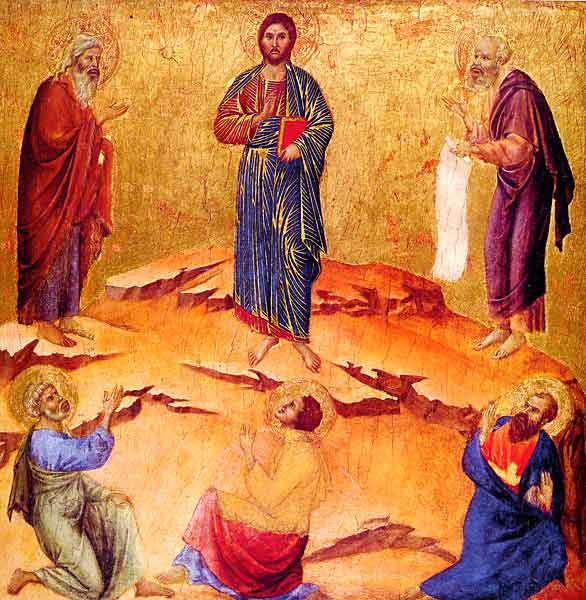
The Gospel according to Matthew describes that indescribable event with these words: “Jesus was transfigured (literally “he changed his appearance”) before Peter, James and John: his face shone like the sun and his garments became as white as light” (Matthew 17:2). In this feast, which is almost ignored or inattentively celebrated because of the elation caused by summer holidays by which many Christians are caught, Christ’s face is contemplated, a face that is radiant with a light addressed to the whole universe, to the whole mankind because it is the light of God’s life which wants to reach each creature through Christ: a light of life and communion.
And yet, since the moment when it was fixed by the monks of Palestine, the choice of the beginning of August for this commemoration has had also another coincidence which is extremely full of meaning: as a matter of fact, according to the Hebrew calendar the 9 of the month of Av falls on those very days, a day of fast and mourning during which the people of Israel commemorates the destructions of the first and the second Temple of Jerusalem (which occurred respectively in 586 BC and in 70 AD). Since then, the people of Israel also commemorates all the tragedies which marked Jewish history, such as the expulsion from Spain in 1492, till the utmost “catastrophe,” the shoah of the Nazi massacre of the last century.
Thus, born to contemplate Christ as the new Temple, not made by human hands, coinciding with the commemoration of the destruction of the Temple built by men, born to celebrate the destiny of light that awaits each man, the Transfiguration ended by having its meaning tragically enriched by the memory of a light — which blinds the hit mankind and makes the mankind that causes it ugly — and of the commemoration of the annihilation of the place and of the people chosen by God to reveal Himself. While Christians, in their churches filled with light, celebrate God’s glory which is refulgent on Christ’s face, the Jews read the book of the Lamentations in their synagogues, which are almost dark because of the dim light of only one candle. And the shadow of a gloomy and disquieting glow of death lies heavy on everybody, the bright cloud of a exterminating light. An upsetting paradox: the light of life of the Transfiguration, which comes from God and announces the future of the world in Christ, contrasts with the light of death produced by men which threatens the present of the world and compromises its tomorrow. The Transfiguration reminds us of the beauty to which mankind and the whole universe are destined, Hiroshima and the shoah witness the brutalization of which men are able; the Transfiguration evokes, assembling it in Christ, the glory to which the human body is destined, the cosmos itself, Hiroshima and the shoah reveal men’s ability to disfigure human flesh, to deform body and soul, to ravage the cosmos.
For a Christian the celebration of the Transfiguration is then also an appeal to responsibility and an exhortation to sympathy, to dilate our heart towards the suffering man. It is not a case that, according to the Gospels, the Christ who experiences the transfiguration is the one who has just announced for the first time the fate of passion and death that awaits him, the disfigurement he will suffer because of men (see Matthew 16:21-23): in front of evil, Jesus chooses to be its victim rather than being its minister. Thus, the Transfiguration becomes God’s affirmative answer to the Son who accepts the path of a thorough solidarity with the oppressed and the victims of history. The mystery contained in the heart of the Transfiguration itself is then the mystery of suffering: it finds its logic in the Easter dynamism of death-resurrection, of suffering-vivification.
Moreover, if the 9 of Av evokes the Jews’ sufferings and Hiroshima reminds us of the all men’s sufferings, Christ (who is an Hebrew and will be an Hebrew forever) is the one who gathers in his human body, in his Hebrew flesh, the whole mankind’s sufferings. And his Transfiguration becomes universal hope for each sufferer, indeed for the whole creation that groans waiting for redemption (see Romans 8:22). It is then Christians’ duty to celebrate the Transfiguration hoping for all men; as a matter of fact the memory of this event of Jesus’ life is the promise that also our body of misery and sin will be changed, so that God’s full image can be reestablished inside us. The Transfiguration is the sign worked by God to conform us to his Son, till he makes us like him. It is also the warrant that all our being will be transfigured, with no break in our human situation: also our passions, our senses, our human affections will not be destroyed but they will be transfigured through a purification whose protagonist is God. If it is experienced in this wait, the Transfiguration will be a feast that, already in the present moment, will light gleams of hope in the hearts and will enlighten consciences arousing sympathy, co-responsibility, true fraternity.
Enzo Bianchi
{link_prodotto:id=320}
pp. 131-134