A piece of earth transplanted in heaven
by ENZO BIANCHI
We love this our earth, yet we feel constrained here; we are preoccupied about our bodies, yet feel that we are greater than our physical make-up
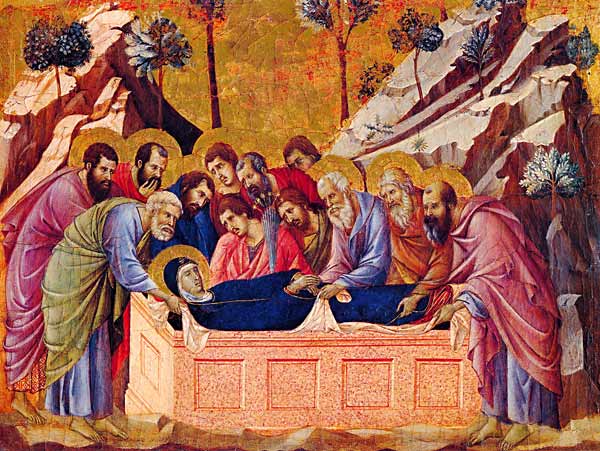
15 August, The passing of the B.V. Mary
Mid-August, when summer reaches its peak and begins to decline, a period of vacation in continual balance between rest and over-exposure of the body, between relaxation and bewilderment of the spirit, between opening and confusion of the mind: and in the heart of this “time for man” in his wholeness comes what is perhaps the most popular feast among those in honor of the Virgin Mary: the Assumption. Incomprehensible paradox? Contradiction of a society that by now is branded by many as secularized? Parallel worlds that criss-cross in a holiday that is common to all as far as the day goes, but not as far as the reasons for it? I think rather of a fruitful provocation. Since the earliest centuries, in fact, the Church has perceived that in Mary – the woman who in the name of all creation had received God made man and had borne Him who rose from the dead – was prefigured not only the way, but also the end that awaits everyone living: the assumption of what is human, of everything that is human into the divine. Yes, Mary is the image and corporate personality of the faithful because she is the Daughter of Zion, the holy Israel from whom was born the Messiah, and is also the Church, the Christian community that under the cross gives birth to children for the Lord. For this reason the Visionary of the Apocalypse contemplated her as the woman robed with the sun, crowned with the twelve stars of the tribes of Israel, giving birth to the Messiah (cf. Ap 12:1-2), but also as the mother of Christ’s progeny, the Church (cf. Ap 12:17). The first creature to enter “body and soul” – that is, with all of herself – into the Creator’s space and time could thus be no other than she who had given her consent that the divine might burst upon the human: vital space given by the earth to heaven, the Virgin Mother becomes the germ and first fruit of a transfigured creation. According to the belief of the Church, Mary is now beyond death and beyond judgment, in that other dimension of existence that we are unable to call anything else than “heaven.”
In this term there is no opposition, but rather an embrace with earth: indeed, who can say, looking within and around himself or gazing at the distant horizon where earth finishes and heaven begins? Is earth only the broken-up clod and the impervious rock, or is it not also the crust that hardens our heart? And heaven: is it only the starry vault and not the living breath that abides there? Thus Mary, assumed to God, remains infinitely human, forever Mother, turned towards the earth, heedful of the sufferings of men and women of all times and places, present to their often uncertain wandering. Yes, for the Christian East as for the Christian West, in spite of different formulations, Mary’s Dormition-Assumption is a sign of the “last realities”, of what is to occur in a future not so much chronological as of “sense”, a sign of the fullness towards which our limits aspire: in her we have an intuition of the glorification that awaits the entire cosmos at the end of time, when “God will be all in all” (1 Cor 12:28) and in everything. She is the part of humanity already redeemed, figure of that “promised land” to which we are called, a piece of earth transplanted in heaven.
This “hope for all” is what the liturgy has always attempted to sing on this feast, with the language and images at its disposal. Perhaps today some liturgical expressions and some iconographic representations seem to us inadequate, but the aspiration that they endeavored to express remains the same also in our days and even in the din of the mid-August holidays. We love this our earth, yet we feel constrained here; we are preoccupied about our bodies, yet feel that we are greater than our physical make-up; we struggle for time and against time, yet perceive that our truth is greater than time; we enjoy friendship and love, yet recognize our limits and fear its transiency. Perhaps a humble woman of Nazareth, who became by God’s gift the Mother of the Lord, is just the pledge for us of this possibility “to think big” – which is a broadening of horizons and not of covetousness, greatness of spirit and not of pretensions. In that case that body transplanted towards the Light that is the source and destination of every light does not regard only the devotion of some faithful, but the final destiny of the entire creation assumed by the Uncreated; it is the flesh itself of the earth, which, transfigured, becomes eucharist, thanksgiving, embrace with heaven.
Yes, on the feast of Mary assumed into heaven Christians are invited in this period of vacations to transform into thanksgiving, eucharist, a rendering of thanks to the Creator and to the Savior the creation that they contemplate and that they ought to guard with love and care.
From:
ENZO BIANCHI
{link_prodotto:id=320}
pp. 137-139.